

7th International Conference on Plants and Environmental Pollution Begins at CSIR-NBRI
- Source Samvidhan News
- Nov 30, 2025
- Share:
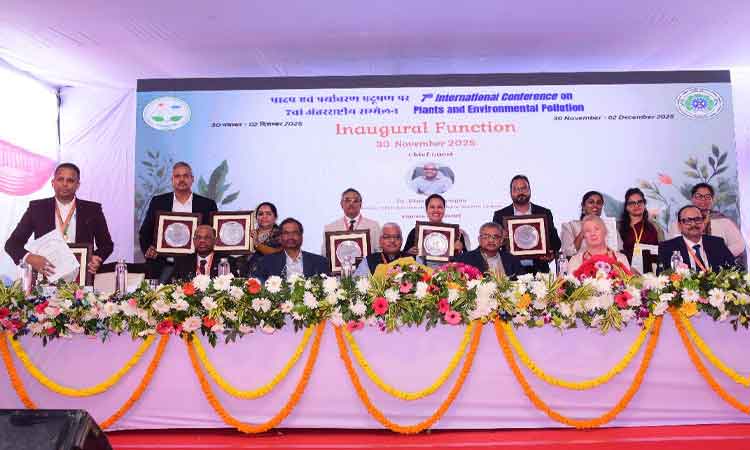
The 7th International Conference on Plants and Environmental Pollution (ICPEP-7) commenced today on 30 November 2025 with a formal Inaugural Function at CSIR–National Botanical Research Institute (CSIR-NBRI), Lucknow. Jointly organized by the International Society of Environmental Botanists (ISEB) and CSIR-NBRI, this global scientific gathering brings together renowned experts and scholars to discuss challenges and innovations in plant biology, climate resilience, and environmental restoration. The central theme of the conference is “Plants & Ecosystems for Advancing LiFE (Lifestyle for Environment), Green Growth, and Sustainable Future”
The inaugural session was graced by the Chief Guest, Dr. Bhaskar Narayan, Director, CSIR-Indian Institute of Toxicological Research (CSIR-IITR), Lucknow, along with distinguished Guests of Honour — Prof. S. K. Barik (NEHU, Shillong), Prof. Elina Oksanen (University of Eastern Finland), and Prof. Swadhin Behera (JAMSTEC, Japan).
In his welcome remarks, Dr. A. K. Shasany extended a warm greeting to all assembled dignitaries, participants, and international delegates. He highlighted the historic legacy of CSIR-NBRI, which has served as a pioneering center of plant science research for over six decades. Dr. Shasany also shared significance of hosting ICPEP-7 at CSIR-NBRI and emphasized the crucial role of plants as ecological indicators and natural agents of environmental remediation.
Dr. Soumit K Behera, Organizing Secretary, ICPEP-7 & Senior Principal Scientist, CSIR-NBRI informed that ICPEP-7 has attracted an overwhelming response from researchers across India and abroad. A large number of scientific abstracts have been received, reflecting the growing global urgency around environmental issues. More than 300 participants are attending the event, including scientists, researchers, policymakers, industry professionals, government representatives, and students from India and abroad. Notably, about 250 delegates from India, including 30 from foreign countries (Bangladesh, Finland, Japan, Mexico, Portugal, Spain, Russia, Sweden, the UK, and the USA), are participating, adding a strong global perspective to the dialogue.
Guest of Honour of the inaugural function, Prof. Elina Oksanen, University of Eastern Finland, Finland highlighted cross-continental learning opportunities, urging greater collaboration between European and Indian research institutions. Her remarks emphasized the increasing relevance of studying plant responses to extreme environments as indicators of evolving climate patterns.
Prof. Swadhin Behera, JAMSTEC, Japan, Guest of honour of the function, global climatic systems, ocean–atmosphere interactions, and predictive environmental modeling using advanced simulation technology. With expertise linking climate science to agricultural and ecological contexts, he underscored the need for integrating climate forecasting into environmental management and plant-based mitigation strategies.
Prof. S. K. Barik, North-Eastern Hill University, Shillong & former director, CSIR-NBRI recalled the visionary contributions of the founder president of ISEB and the past scientists associated with the Society, underscoring their legacy in advancing environmental botany. Prof. Barik called for collective global efforts and coordinated climate action to combat rising pollution levels and emerging environmental challenges.
The chief guest of the function, Dr. Bhaskar Narayan, Director, CSIR-IITR, Lucknow, in his inaugural remarks, emphasized the urgent need to utilize plant-based scientific research to counter the growing threats of environmental pollutants. He highlighted the role of botanical research in toxicology, ecosystem monitoring, and sustainable development, underscoring how inter-institutional collaborations can accelerate real-world environmental solutions. He praised ISEB and CSIR-NBRI for their leadership in promoting eco-centric research and capacity building in environmental science. Dr. Bhaskar Narayan invoked the principle of “प्रकृति रक्षति रक्षिता” — meaning nature protects those who protect it — to emphasize the deep-rooted cultural understanding of environmental stewardship in Indian ethos. Dr. Narayan reiterated the need to tap, lead, and start development towards saving our Mother Earth, noting that humanity has long taken nature for granted and must now act responsibly to preserve it for future generations.
The dignitaries also released abstract book and souvenir of the conference on the occasion. The dignitaries also felicitated the fellows of ISEB Fellowship & Young Scientists Medal for the year 2023 & 2024.
ISEB Fellowship & Young Scientist Medals Announcements (2023–2024)
ISEB Fellowships (2023–2024)
ISEB honoured distinguished scientists with Fellowship recognitions:
• Prof. Purabi Saikia (BHU) – invasive ecology & forest carbon research
• Dr. Narendra Kumar (BBAU) – pollutant dynamics & river ecosystem studies
• Prof. Anil Prakash (Barkatullah Univ.) – microbe–plant interactions & effluent degradation
• Dr. Avinash Kaur Nagpal (GNDU) – heavy-metal toxicity & air-pollution tolerance in plants
• Prof. Bandana Bose (BHU) – innovator of Nitrate Seed Hardening Technology
• Prof. Shashi Pandey (BHU) – molecular plant stress & phytoremediation
• Dr. Soumit K. Behera (CSIR-NBRI) – climate ecology & leaf-area index methods
• Dr. Puneet Singh Chauhan (CSIR-NBRI) – beneficial microbes & biostimulants research
• Dr. Richa Kothari (CU Jammu) – waste remediation & resource recovery technologies
• Dr. Chandra Shekhar Seth (DU Delhi) – abiotic stress signalling & phytoremediation insights
ISEB Young Scientist Medals (2023–2024)
Recognizing excellence in emerging researchers:
• Dr. Dipali Srivastava (NCSU, USA) – metal-stress tolerance signalling
• Dr. Ritika Srinet (Helsinki University) – climate-forest modelling
• Ms. Priya Priyadarshini (IIT Hyderabad) – smart-city solid-waste management
• Dr. Shobhit Raj Vimal (Allahabad Univ.) – microbial inoculants & soil restoration
• Dr. Pujarini Samal (CSIR-NBRI) – palaeoclimate & mangrove ecology
On 30 November 2025, the conference featured three major plenary speakers in the inaugural plenary session — Prof. Elina Oksanen, Prof. Swadhin K. Behera, and Prof. Saroj K. Barik, followed by an additional four plenary talks in the afternoon session by leading experts including Prof. P. V. Vara Prasad, Prof. Viney P. Aneja, Prof. Om Parkash Dhankher, and Dr. Prabodh K. Trivedi, making a total of seven plenary speakers on the opening day, accompanied by 18 oral presentations across multiple technical sessions and parallel tracks, reflecting the depth and diversity of scientific contributions. The talks and presentations spanned critical themes including biodiversity conservation, climate resilience, phytoremediation, agricultural sustainability, environmental monitoring, and plant–pollutant interactions.
Dr. Vivek Pandey, Vice-President presented the vote of than in the end.

Top Stories
Stay in Touch

Subscribe to our Newsletter