

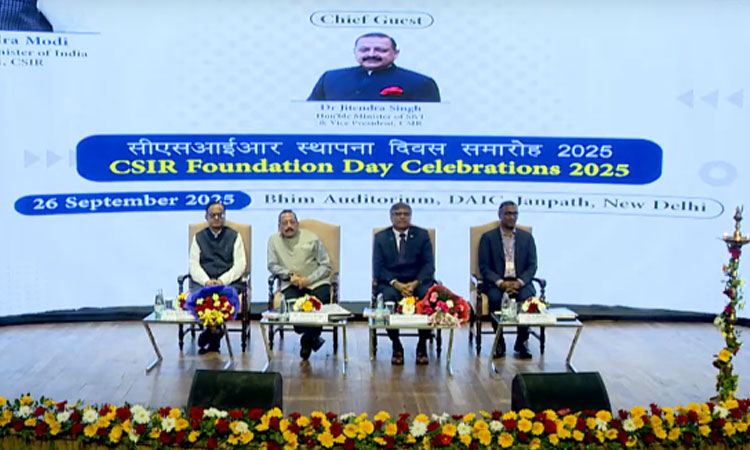
84th CSIR Foundation Day Celebrations 2025
- Source Samvidhan News
- Sep 26, 2025
- Share:
Union Minister of State (Independent Charge) for Science & Technology and Vice President of CSIR, Dr. Jitendra Singh, today asserted that “technology sovereignty will determine geopolitical sovereignty in the times to come”, as he underlined India’s transition into a technology-driven nation.
Delivering the keynote address at the 84th Foundation Day of the Council of Scientific and Industrial Research (CSIR) in New Delhi, Dr. Singh emphasized the organization’s legacy, its scientific milestones, and its responsibility in shaping the nation’s journey towards Viksit Bharat @ 2047.
He recalled that CSIR, founded in 1942—before India’s Independence—has remained at the forefront of national development. Paying tribute to Dr. Syama Prasad Mookerjee, the first Vice President of CSIR, and Sir Ramnath Chopra, considered the father of Indian pharmacology, Dr. Singh noted their pioneering contributions that laid the foundations of India’s R&D ecosystem. “CSIR’s history is a reminder that science and innovation were integral to India’s journey even before freedom,” he said.
Highlighting the institute’s present role, Dr. Singh said CSIR, with its 37 laboratories across the country, has been contributing to healthcare, pharmaceuticals, agriculture, materials science, aerospace, and defence. He stressed the need for greater integration across scientific institutions and cited the development of Nafithromycin, India’s first indigenously developed antibiotic for drug-resistant respiratory infections, as a successful example of collaboration.
Industry partnerships, he noted, are crucial for translating innovations from “lab to marketplace.” “All our success stories—from vaccines to floriculture—have been possible because of early and robust engagement with industry partners,” he said, urging companies to take greater ownership of innovations emerging from Indian laboratories.
The Minister also underlined the societal impact of CSIR’s work, including the lavender revolution in Jammu & Kashmir, tulip cultivation in Himachal Pradesh, and security technologies like sensors used in Operation Sindoor. He stressed that the ultimate aim is to improve the ease of living and bring direct socio-economic benefits to citizens.
Looking ahead, Dr. Singh proposed a three-pronged approach—Awareness, Affordability, and Accessibility—to ensure science reaches the widest sections of society. He encouraged scientists to embrace modern communication platforms and social media for better public engagement.
The event was attended by eminent personalities including Dr. V. K. Saraswat (Member, NITI Aayog), Prof. Ajay Kumar Sood (Principal Scientific Adviser to the Government of India), and Dr. Sethuraman Panchanathan (Arizona State University, and former Director, U.S. National Science Foundation).
Concluding his address, Dr. Singh said CSIR must aspire to be the torchbearer of India’s technological rise as it approaches its centenary in 2042. “The real tribute to our founding fathers will be to carry science to every section of society and lead the nation into 2047 with confidence and capability,” he remarked.

Top Stories
Stay in Touch

Subscribe to our Newsletter