

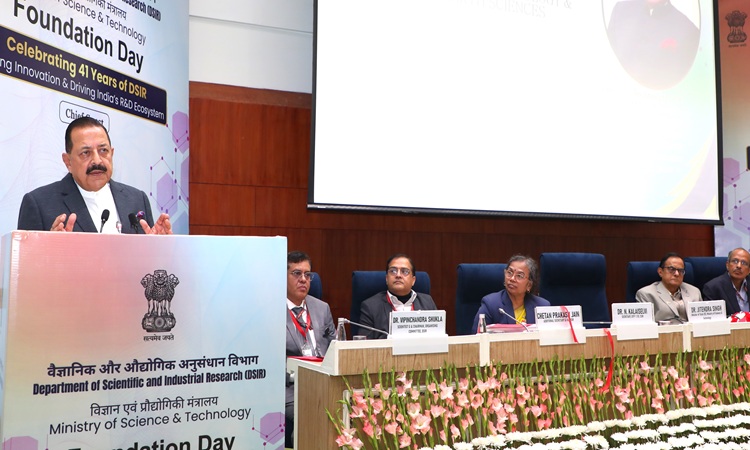
Celebrating 42nd Foundation Day of DSIR, Government Announces Relaxation for Deep-Tech Startups
- Source Samvidhan News
- Jan 04, 2026
- Share:
On the occasion of the 42nd Foundation Day of the Department of Scientific and Industrial Research (DSIR) under the Ministry of Science & Technology, Union Minister of State (Independent Charge) Dr. Jitendra Singh announced a major policy reform aimed at strengthening India’s deep-tech startup ecosystem. The government has relaxed the mandatory three-year existence condition for deep-tech startups to obtain recognition under DSIR’s Industrial Research and Development Promotion (IRDP) Programme. This move is expected to provide early momentum to young innovators and first-time entrepreneurs, enabling promising startups to scale faster at an early stage of their journey.
Addressing the gathering, the Minister said that while the ₹1 lakh crore Research, Development and Innovation (RDI) Fund has generated unprecedented enthusiasm nationwide, it is designed to support startups that have already reached a certain level of technological maturity. He emphasized that for early-stage innovators, a wide basket of schemes already exists across departments such as DST, CSIR and TDB. The removal of the three-year condition, he said, reflects the government’s trust in Indian innovators and its confidence in their sustainability, while continuing to maintain robust evaluation standards linked to technological maturity.
Dr. Jitendra Singh highlighted that CSIR has been extending financial assistance to startups in the past, including loans of up to ₹1 crore, but these were subject to the mandatory requirement of demonstrating sustainability over three years. With this condition now removed, the reform serves as a significant incentive to accelerate and sustain new deep-tech startups even before they are fully established. Congratulating the DSIR family, the Minister described the relationship between DSIR and CSIR as an “intergenerational symbiosis,” where both institutions complement and strengthen each other, transforming interdisciplinary science into intergenerational collaboration critical for India’s innovation ecosystem.
The Minister further stated that India has moved beyond the goal of Atmanirbhar Bharat and is now entering a phase where other nations are increasingly dependent on Indian capabilities. Citing examples from vaccines, medical devices and indigenous technologies, he noted that India has transitioned from import dependence to exports worth several crores, reflecting growing global acceptance of Indian science and technology. Emphasising DSIR’s four pillars—Science, Industry, R&D and Technology Transfer—he underlined the importance of industry as an early partner in meaningful research and highlighted DSIR’s expanded role in providing fiscal incentives to encourage industry, MSMEs and startups to collaborate in government-supported R&D.
The Foundation Day celebrations witnessed the launch of four major initiatives: the DSIR Guidelines for Recognition of In-House R&D Centres of Deep-Tech Startups, the PRISM Network Platform – TOCIC Innovator Pulse, Creative India 2025 under the PRISM scheme, and the DSIR Disaster Management Plan. Several important MoUs and technology transfer agreements were also exchanged, including an agreement under the Technology Development and Utilisation Programme for Women to establish a Skill Satellite Centre in Dhamtari, Chhattisgarh, and licensing of technologies developed under the Common Research and Technology Development Hubs Programme to industry partners, strengthening MSME-focused R&D infrastructure.
Senior leaders from across the science and innovation ecosystem participated in the event, including Dr. N. Kalaiselvi, Secretary, DSIR; Prof. Ajay Kumar Sood, Principal Scientific Advisor to the Government of India; and secretaries from MSME and Earth Sciences. Dr. Kalaiselvi highlighted DSIR’s role as a vital bridge between government, academia and industry, while Prof. Sood stressed the importance of technology sovereignty, scaling innovations from lab to market, and strengthening private-sector R&D. Concluding the event, Dr. Jitendra Singh reaffirmed that the relaxation of the three-year existence criterion is driven by a noble intent to accelerate startups and build a future-ready, technology-sovereign India.

Top Stories
Stay in Touch

Subscribe to our Newsletter