

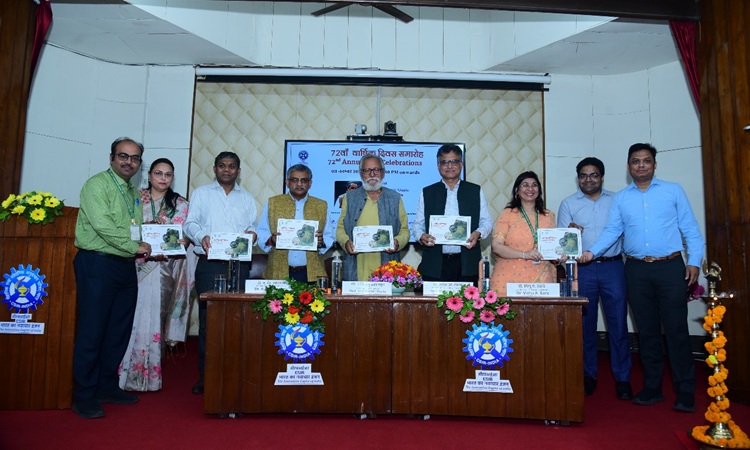
CSIR-National Botanical Research Institute, Lucknow celebrates 72nd Annual Day
- Source Samvidhan News
- Nov 04, 2025
- Share:
The CSIR-National Botanical Research Institute (CSIR-NBRI), Lucknow celebrated its 72nd Annual Day with great enthusiasm. On this occasion, Prof. Anil Kumar Gupta, Founder of the Honey Bee Network and former Professor at the Indian Institute of Management (IIM) Ahmedabad, graced the event as the Chief Guest. He delivered the Annual Day Lecture on the topic “Bio-entrepreneurship Options for Aspirational Communities: Towards Ethical and Responsible Science.”
The dignitaries released the Annual Report 2024–25 of the institute on this occasion. Director Dr. Ajit Kumar Shasany presented the annual progress report and highlighted the major scientific achievements and initiatives of the institute during the review year.
The institute achieved several remarkable milestones this year. These include the development of the world’s first pink bollworm-resistant GM cotton, generating a record licensing revenue of ₹4 crore; expansion of India’s plant biodiversity records through the discovery of 19 new lichen species and several new flowering plants; and scientific validation of traditional medicine by establishing the efficacy of Coptis teeta extracts in treating arthritis and urolithiasis.
To promote sustainable agriculture, the institute developed environment-friendly technologies such as biochar-based arsenic treatment, microbe-assisted pollution control, and eco-safe growth enhancers. In the field of ornamental horticulture, four new chrysanthemum varieties—Stuti, Saraswati, Jagannath, and Padma—were released, while superior flax and cotton varieties were identified for drought tolerance and improved yield.
The institute rediscovered the rare plant species Swertia wattii after 138 years and established a Heritage Tree Garden and Tulsi Garden. Under the CSIR Aroma and Floriculture Missions, extensive outreach programs were conducted to promote green livelihoods among farmers.
Promoting a sustainable bio-economy, CSIR-NBRI transferred 13 green technologies to industries, including herbal gulal, sindoor, temple-flower-based Shiv Bhasma, and lotus-based products. During the year, the institute published 189 SCI papers (total impact factor 638.2), filed five patents, initiated 23 new research projects, and signed 29 national and international collaborations.
Chief Guest Prof. A.K. Gupta congratulated the scientific community of the institute for their outstanding achievements and emphasized strengthening research related to traditional knowledge. He stressed the need to build a network of research students across universities, sustainably utilize biodiversity resources, and promote bio-entrepreneurship.
During the event, CSIR-NBRI signed two Memorandums of Understanding (MoUs) to strengthen collaborative research. The first MoU was signed with the Birbal Sahni Institute of Palaeosciences (BSIP), Lucknow for joint R&D initiatives in plant sciences and allied interdisciplinary fields, and the second with the H.S. Srivastava Foundation for Science and Society to promote collaborative research, innovation, and outreach in plant biotechnology and environmental sustainability.
The dignitaries also inaugurated the institute’s new bilingual website. Scientists from various R&D divisions were felicitated with the Prof. K.N. Kaul Best Research Paper Certificates for publishing the highest-impact research papers in their respective areas.
The event concluded with a vote of thanks proposed by Chief Scientist Dr. Vidhu A. Sane. CSIR-NBRI reiterated its commitment to the mission “Science for Society” while advancing the vision of “Viksit Bharat” through innovation, sustainability, and inclusivity.

Top Stories

Stay in Touch

Subscribe to our Newsletter