

Health of India Will Be the Key to Viksit Bharat 2047: Dr. Jitendra Singh at Phenome India’s Cohort Connect 2025
- Source Samvidhan News
- Nov 13, 2025
- Share:
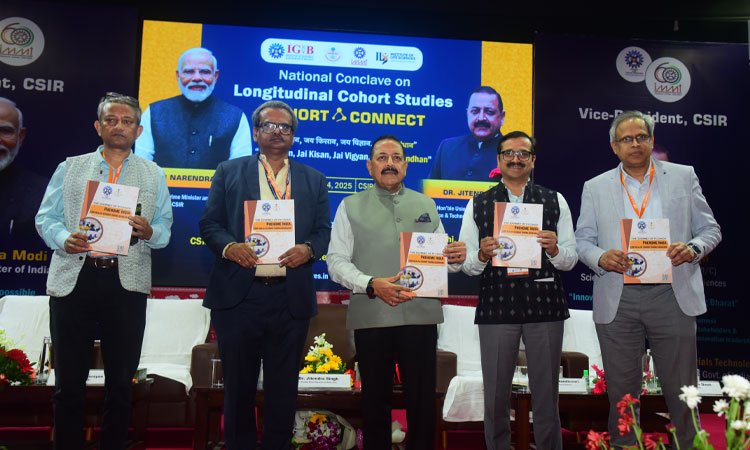
The National Conclave on Longitudinal Cohort Studies: Cohort Connect 2025 commenced on Thursday at the CSIR–Institute of Minerals and Materials Technology (CSIR-IMMT), Bhubaneswar, bringing together scientists, clinicians, data experts, policymakers, and students from across India to strengthen collaboration in population-based longitudinal research. The event was inaugurated by Dr. Jitendra Singh, Hon’ble Union Minister of State (Independent Charge) for Science & Technology and Earth Sciences; Minister of State, PMO, Personnel, Public Grievances, Pensions, Atomic Energy and Space; and Vice President, CSIR, in the presence of senior CSIR leadership, distinguished scientists, and representatives from national health cohorts under the Phenome India – CSIR Health Cohort Knowledgebase (PI-CHeCK) initiative.
In his inaugural address, Dr. Jitendra Singh emphasized that the health of India will be the basic parameter for achieving Viksit Bharat by 2047, remarking that “India’s health at 2047 will be the key to Viksit Bharat.” He lauded the PI-CHeCK initiative, which aims to identify early risk factors and develop India-specific health standards, noting that global models often fail to reflect the country’s unique genetic, dietary, and lifestyle diversity. Highlighting the significance of the project, he said, “A longitudinal cohort study like this addresses the mantra I have always emphasised — Indian prevention strategy for Indian subjects and Indian data for Indian solutions. It will provide vast data for developing our preventive and therapeutic health strategies and integrating them with the private sector to make them more viable and sustainable.” Dr. Singh further noted that India faces a dual health challenge — the continuing presence of communicable diseases alongside a rising burden of metabolic and lifestyle disorders — and underscored the need for studies like Phenome India to understand the complex interplay between genetics, lifestyle, and environment. On this occasion, Dr. Singh released a souvenir highlighting the journey of the PI-CHeCK initiative.
The inaugural session was also addressed by Dr. Ramanuj Narain, Director, CSIR-IMMT; Dr. Vinay K. Nandicoori, Director, CSIR-CCMB; and Dr. Souvik Maiti, Director, CSIR-IGIB. Two Memoranda of Understanding (MoUs) were signed — one between Lloyds Metals and Energy Limited (Maharashtra) and CSIR-IMMT, and another between Fomento (Goa) and CSIR-IMMT — in line with the Government’s vision to promote close coordination among R&D institutions, academia, and industries.
Welcoming the participants, Dr. Ramanuj Narain said it was a historic moment for CSIR-IMMT to host leading scientists and doctors under one roof, symbolising a “flower blooming in stone” — a convergence of materials science and medical science for the national good. He added that under the visionary leadership of Dr. Jitendra Singh and CSIR DG Dr. N. Kalaiselvi, the conclave strengthens India’s march toward Viksit Bharat, Atmanirbhar Bharat, and a future anchored in personalised and digital health. The event featured participation from leaders of major national cohorts, including LASI-DAD, ICKD, CARRS, BIRPOP, GARBH-Ini (DBT Initiative), and Phenome India, as well as representatives from AIIMS, ICMR, DBT, and Oil India.
Dr. Souvik Maiti, Director, CSIR-IGIB, described the conclave as a vital platform for collaborative health research across the country. Dr. Shantanu Sengupta, Principal Investigator of PI-CHeCK, said the long-term scientific goal of Phenome India’s longitudinal study is to develop clinically useful risk prediction scores for cardio-metabolic disorders such as diabetes, pre-diabetes, and liver fibrosis. The first day of the conclave featured four technical sessions focusing on topics like interoperable health data systems, dementia diagnostics, kidney disease, indigenous health, and cardiometabolic studies. A poster session in the afternoon displayed more than 40 research studies from young scientists and students across India.
The second day will focus on diabetes and metabolic disorders, maternal and child health, and environmental health linkages, featuring eminent experts such as Dr. Nikhil Tandon, Dr. Chittaranjan Yajnik, Dr. Sudha Vasudevan, and Dr. Jeemon P. A panel discussion on “Data Sharing and Ethics in Cohort Studies,” chaired by Dr. Sandeep Seth and Dr. Sanghamitra Bandhopadhyay, will deliberate on frameworks for ethical and interoperable data sharing across research networks. The conclave will conclude with a valedictory session highlighting key takeaways and a roadmap for advancing collaborative cohort science in India.
The Phenome India – CSIR Health Cohort Knowledgebase (PI-CHeCK), launched in December 2023, is a flagship CSIR initiative to establish India’s first comprehensive longitudinal health cohort integrating clinical, biochemical, genomic, proteomic, metabolomic, imaging, and microbiome data. With over 10,000 participants enrolled across 37 CSIR laboratories in 16 states, PI-CHeCK aims to create robust, India-specific disease risk models and lay the foundation for a new era of precision health research in the country.

Top Stories
Stay in Touch

Subscribe to our Newsletter