

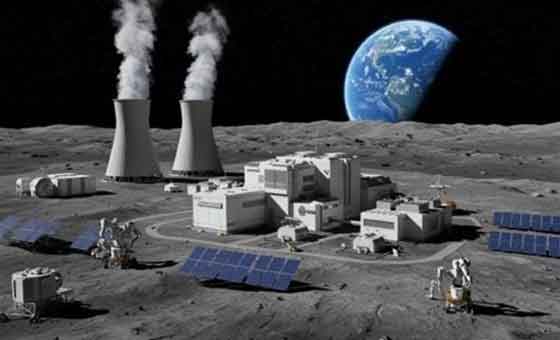
First Nuclear Reactor on the Moon Planned by 2030
- Source Samvidhan News
- Aug 19, 2025
- Share:
After the first successful landing on the Moon, plans are now being made to build nuclear reactors there. This will make deeper research on the lunar surface easier. While it took decades to set foot on the Moon, today the main goal is to stay there permanently and use its resources. In April 2025, China announced that by 2035 it would establish a nuclear power plant on the Moon to support its proposed International Lunar Research Station. In August, NASA’s acting administrator Sian Duffy also stated that an American nuclear reactor could be operational on the Moon by 2030. For years, NASA and the U.S. Department of Energy have been working on small nuclear power systems to supply energy to lunar bases, mining operations, and long-term habitats. Since the 1960s, the U.S. and the Soviet Union have relied on radioisotope generators to power satellites, Mars rovers, and Voyager probes.
The United Nations’ 1992 principles state that nuclear power may be necessary where solar energy is insufficient. The 1967 Outer Space Treaty, signed by major spacefaring nations including the U.S., China, and Russia, guarantees that all countries have the right to explore and access the Moon but prohibits territorial claims or sovereignty. Therefore, building a nuclear reactor on the Moon is not illegal, but how it is implemented is of critical importance.
The establishment of a nuclear reactor on the Moon is not a declaration of war, but it represents a base—a symbol of a nation’s presence and capability. This is especially significant in the Moon’s south pole, where ice trapped in permanently shadowed craters could provide rocket fuel. Constructing a base there would strengthen a nation’s capacity to harness lunar resources while limiting others from doing so. Such efforts will ensure long-term presence on the Moon and give countries an edge in technology, resources, and power projection. In the coming era, bases will become the primary measure of space power.

Top Stories




Stay in Touch

Subscribe to our Newsletter