

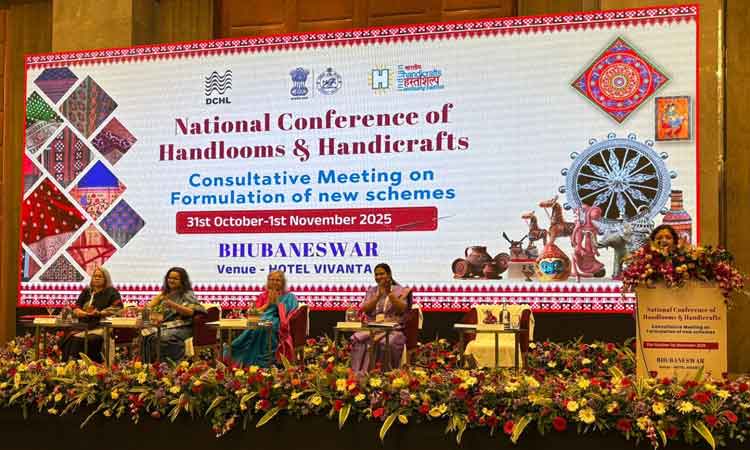
National Conference on Handlooms & Handicrafts Concludes in Bhubaneswar
- Source Samvidhan News
- Nov 02, 2025
- Share:
The National Conference on Handlooms & Handicrafts, organized by the Union Ministry of Textiles, Government of India, concluded on Saturday in Bhubaneswar, celebrating India’s timeless weaving traditions and exploring pathways for innovation and sustainable growth.
The two-day conference aimed to empower artisans, promote India’s craft economy, and strengthen the handloom and handicraft sectors through knowledge sharing, innovation, market integration, and collaboration among states.
Inaugurating the conference, Odisha Chief Secretary Manoj Ahuja highlighted India’s rich textile heritage and called for continued efforts to foster innovation, inclusivity, and sustainability in the artisan ecosystem.
Addressing the inaugural session, Veena Kumari Meena, Development Commissioner (Handlooms), and Amrit Raj, Development Commissioner (Handicrafts), Ministry of Textiles, emphasized India’s vision to enhance artisan livelihoods and establish Indian handlooms and handicrafts as global symbols of sustainability and inclusive development.
Delivering the welcome address, Guha Poonam Tapas Kumar, Secretary, Handlooms, Textiles & Handicrafts Department, Government of Odisha, reiterated the state’s commitment to empowering weavers and artisans through programmes that bridge tradition with technology and strengthen value chains across the sector.
Following the inauguration, a series of thematic sessions showcased best practices from across India, focusing on key areas such as market linkages, cluster development, infrastructure creation, welfare measures, skill enhancement, and raw material supply.
The opening session, titled “Market Connect: Expanding Reach, Building Brands,” featured presentations from Assam, Haryana, Uttar Pradesh, and Rajasthan, highlighting state-led models that enhance market access and global recognition for local artisans.
Subsequent sessions focused on cluster-based development (Andhra Pradesh, Karnataka), infrastructure and craft villages (Madhya Pradesh, Odisha, Meghalaya, Nagaland), and welfare and skill development initiatives (Tamil Nadu, Odisha, Himachal Pradesh). The conference concluded with an Open House Discussion, fostering a collaborative exchange of ideas among participants.
The national conference served as a dynamic platform for policymakers, artisans, and industry stakeholders to deliberate on challenges, share innovations, and outline a collective roadmap for the future of India’s handloom and handicraft sectors.

Top Stories

Stay in Touch

Subscribe to our Newsletter