

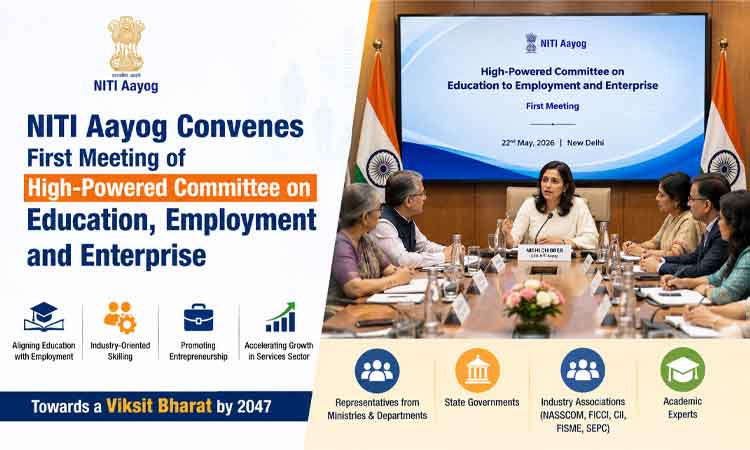
NITI Aayog Convenes First Meeting of High-Powered Committee on Education, Employment and Enterprise
- Source Samvidhan News
- May 25, 2026
- Share:
In line with the Union Government’s vision to fulfil the aspirations of India’s youth and strengthen the country’s capacity in the Services sector, the Union Budget 2026-27 had announced the formation of a High-Powered “Education to Employment and Enterprise” Standing Committee. The initiative, highlighted in Para-51 of the Budget Speech by Finance Minister Nirmala Sitharaman, aims to support India’s target of achieving a 10 percent share in the global services market by 2047. The Committee has been tasked with identifying priority areas to optimise growth, employment, and exports, while also assessing the impact of frontier technologies, including Artificial Intelligence, on jobs and future skill requirements.
Accordingly, a high-level Committee has been constituted under the chairpersonship of Nidhi Chibber, CEO of NITI Aayog, with representation from key Ministries and Departments of the Government of India, State Governments, industry associations, and experts from academia. The Committee includes representatives from the Ministry of Labour and Employment, Department of Commerce, Department of Economic Affairs, Ministry of Electronics and Information Technology, Department of Higher Education, Ministry of Skill Development and Entrepreneurship, Department of School Education and Literacy, Ministry of Statistics and Programme Implementation, as well as the Governments of Andhra Pradesh, Bihar, Maharashtra, and Uttar Pradesh. Industry bodies including NASSCOM, FICCI, CII, FISME, and SEPC are also part of the panel.
On May 22, 2026, NITI Aayog convened the first meeting of the Standing Committee under the leadership of Nidhi Chibber. The meeting was attended by senior officials including Debashree Mukherjee, Debjani Ghosh, representatives from various Ministries and Departments, State Governments, industry associations, and academic experts. During the meeting, Dr. Sonia Pant, Programme Director of the Services Division at NITI Aayog, delivered a detailed presentation highlighting the immense potential of the Services sector in driving economic growth and generating employment opportunities.
Addressing the meeting, Nidhi Chibber stressed the importance of aligning India’s education, skilling, and employment ecosystems with the rapidly evolving requirements of the economy. She noted that India’s demographic dividend presents a significant opportunity to accelerate economic growth through effective policy interventions aimed at creating productive employment and entrepreneurial opportunities for the youth. The discussions during the meeting covered a wide range of issues including labour force participation, youth employment, education and skill alignment, workforce preparedness, and the transition of labour towards non-farm sectors. Participants also deliberated on the growing adoption of frontier technologies such as AI and emphasised the need for strengthening industry-relevant skilling pathways.
The Committee observed that the Services sector continues to play a central role in India’s economic development by contributing to economic resilience, export competitiveness, quality employment generation, and integration with global value chains. Members noted that the sector has the potential to significantly contribute towards the vision of a “Viksit Bharat” by 2047. The Committee decided to hold meetings at regular intervals and focus on actionable recommendations aimed at enhancing employability, promoting entrepreneurship, strengthening industry-oriented skilling, and accelerating growth in the Services sector. The meeting concluded with a collective commitment to transform India’s demographic dividend into a growth dividend through coordinated action among the Centre, States, industry, academia, and the skilling ecosystem, while developing future-ready policy measures to bridge the gap between education, employment, and entrepreneurship.

Top Stories

Stay in Touch

Subscribe to our Newsletter